Effective defense innovation requires more than new legislation
In the preceding parts of this series, available here as Part 1, Part 2, and Part 3, I've laid out the foundational role of the SPEED and FORGED Acts, highlighted the persistent challenges they don’t directly solve, and detailed the path forward for integrating lean innovation. Now, in this final installment, I discuss the overarching strategic imperatives that will ensure our enduring advantage, then conclude the series with a summary of what's needed for lasting transformation.
In Washington, it is easy to believe that the passage of legislation marks the finish line. In reality, it is only the starting gun. The SPEED and FORGED Acts are important steps forward in fixing the Department of Defense’s sluggish acquisition system, but without fundamental cultural and organizational change, they risk being remembered as well-intentioned but toothless reforms.
The question before us is whether America can adapt its defense innovation system to meet the pace of modern conflict—or whether we will be left behind by adversaries who move faster and integrate commercial technologies more aggressively. The answer will depend on whether the Pentagon is willing to break with tradition and build a parallel system, one designed not for incremental reform, but for speed, agility, and integration with the private sector.

The Federal Acquisition Regulation (FAR) was never designed for innovation. It was built to acquire large, mature, well-defined systems—aircraft carriers, fighter jets, satellites. For that purpose, it has worked tolerably well. But when applied to software, AI, robotics, or other rapidly evolving technologies, it grinds innovation to a halt.
Rather than endlessly tinkering with the FAR, the Pentagon needs a new lane: a parallel acquisition system that leverages private capital and commercial innovation at scale. Steve Blank, one of Silicon Valley’s most respected thinkers, has proposed exactly this. He envisions a new defense ecosystem where commercial companies and private investment serve as force multipliers, complementing traditional prime contractors and federally funded labs. Under this model, prime contractors would integrate advanced technologies into complex systems, while the government reserves its in-house labs for areas where commercial markets simply don’t exist—hypersonics, nuclear, energetics.
To make such a system real, Blank has even suggested the creation of an “Under Secretary of Defense for Commercial Innovation and Private Capital”—a cabinet-level voice inside the Pentagon who would have the authority and resources to build and oversee this dual-track approach.
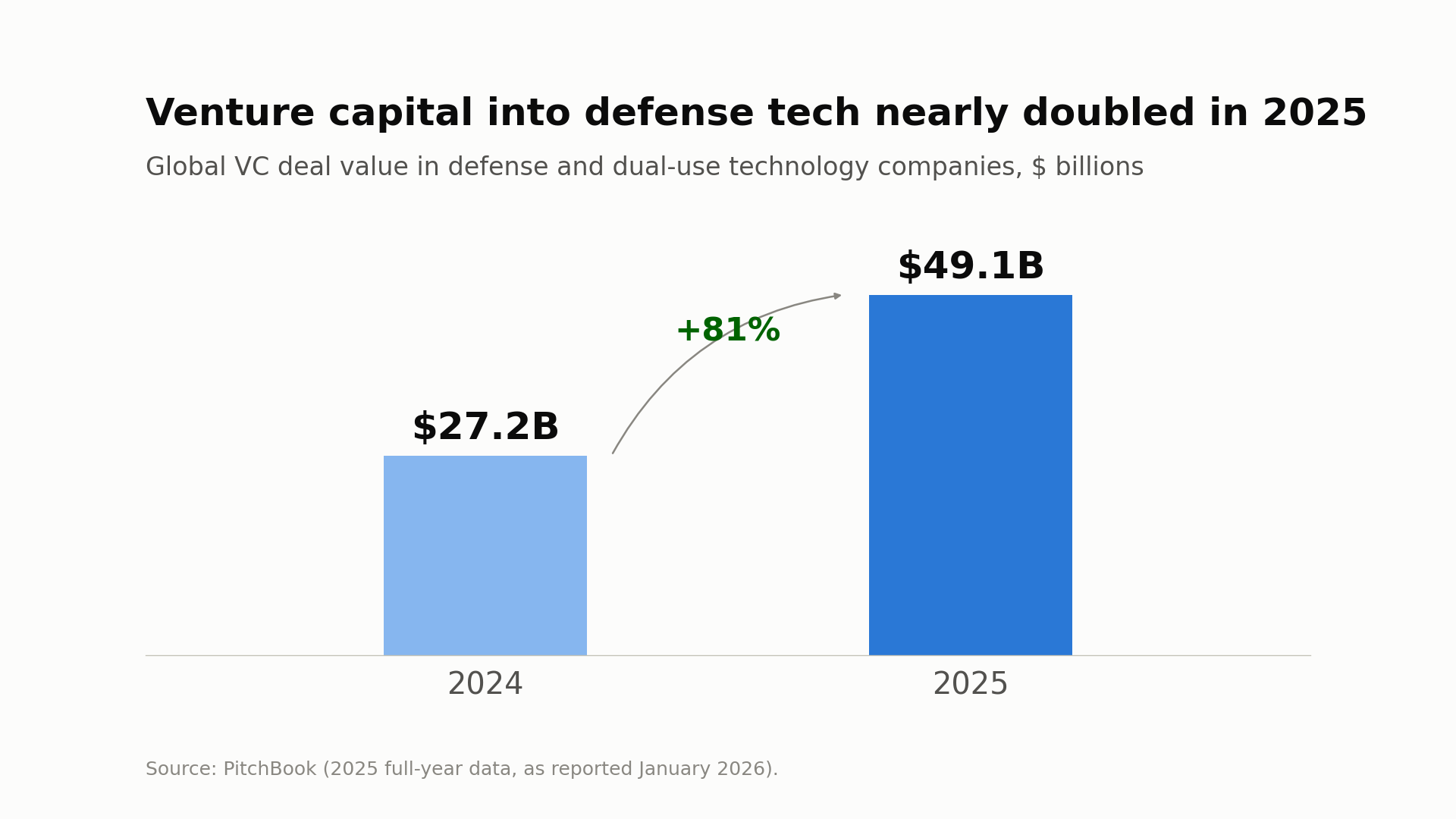
The United States cannot rely solely on appropriated defense budgets to fund innovation. Commercial markets move too quickly, and the pool of private capital is far too large to ignore. Venture and private equity firms are already pouring billions into dual-use technologies like AI, cybersecurity, and autonomy. The Pentagon should be a partner in that ecosystem, not a late-stage customer.
This is not about outsourcing risk; it is about shifting the balance. Let private investors carry more of the burden of early-stage development. Let the Pentagon buy into technologies that have already proven commercially viable and are sustained by market demand. Doing so would give the military access to a wider array of mature, scalable solutions while freeing taxpayer dollars for capabilities that truly cannot be developed outside government.
To achieve this, however, the Department must adopt new financial instruments, new contracting authorities, and new ways of engaging with capital markets. The statutes already give the Pentagon latitude to favor commercial solutions; what is missing is the will and the organizational machinery to make it the default.
The best proof of the case for dual-use innovation lies in the Palantir saga. Soldiers in Afghanistan and Iraq begged for Palantir’s commercial data platform because it simply worked better than the custom-built alternative, the Distributed Common Ground System (DCGS-A). Billions of dollars and years of development could not match the performance of a commercial tool designed to meet user needs.
The lesson is not simply about software. It is about how the military defines success. In traditional acquisition, success is measured by compliance with a set of requirements drafted years earlier. In reality, requirements are often outdated before the ink dries. What matters is not whether a system meets a spec sheet, but whether it solves a real problem for the soldier in the field.
The Army’s now-defunct Rapid Equipping Force (REF) embodied this principle. It listened to troops, rapidly sourced or built solutions, and put them straight into the fight. The REF treated the battlefield itself as a laboratory—deploying “good enough” solutions, gathering feedback, and iterating in real time. That model should be revived and scaled, not consigned to history.
This demands a cultural shift inside the Pentagon. Acquisition officers must stop thinking of themselves as compliance managers and start acting as mission integrators—empathetic, entrepreneurial problem-solvers who treat warfighters as their customers.
Laws like the SPEED and FORGED Acts create authorities. They do not create culture. To translate those authorities into results, the Pentagon must commit to several principles:
The stakes could not be higher. Russia and China are not waiting. They are fusing state direction with commercial innovation to field capabilities faster than we imagined possible a decade ago. If the United States cannot match or exceed that pace, no amount of legacy hardware will secure our advantage.
The Pentagon has a choice: continue tinkering at the margins of a system designed for another era, or embrace the bold shift required to out-think and out-innovate adversaries. The SPEED and FORGED Acts are necessary but insufficient. What comes next—whether the Department builds a truly parallel track for innovation—will determine whether America’s military remains preeminent in the decades ahead.
Anything less risks ceding the future to those who move faster and dare more boldly