Acquisition reform will fail unless Pentagon leaders put warfighter results ahead of bureaucracy
In the first part of this series, I discussed how the SPEED and FORGED Acts provide a crucial legal foundation for accelerating technology delivery, but that deeper cultural and communication challenges remain. Now, let's turn to a concrete example that vividly illustrates these unaddressed issues: the saga of the battle between the U.S. Army and Palantir over the future of the Distributed Common Ground System (the U.S. Army’s primary system to post data, process information, and disseminate Intelligence, Surveillance and Reconnaissance (ISR) information) case study. Palantir is making news today as a result of landing numerous government contracts, but it’s taken a lot to get here. This saga offers invaluable lessons for how the DoD must proceed after the Acts are passed.
Congress has taken steps to accelerate how the Pentagon fields technology with the SPEED and FORGED Acts. But laws alone can’t fix the cultural and bureaucratic habits that slow innovation. For proof, look no further than the Army’s decade-long clash with Palantir over the Distributed Common Ground System–Army (DCGS-A).
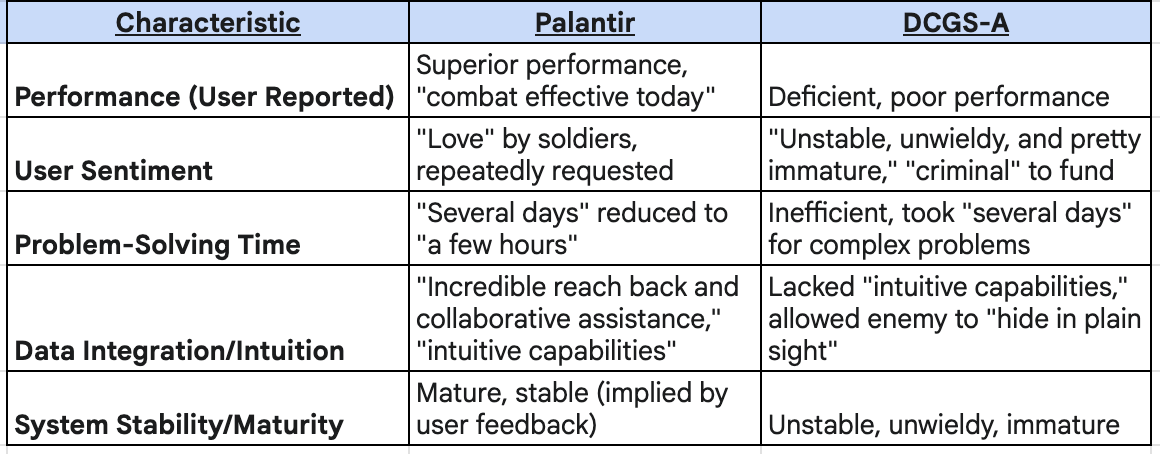
Beginning in 2009, soldiers in Iraq and Afghanistan asked—again and again—for Palantir’s off-the-shelf data analysis software. They said it cut the time to solve complex intelligence problems from days to hours. By contrast, DCGS-A, the Army’s multibillion-dollar homegrown system, was derided in the field as “unstable, unwieldy, and immature.” One intelligence officer described continued funding for DCGS-A as “criminal” given the obvious performance gap.
The requests were not isolated. They came from brigades and divisions across the force. A 2010 urgent need statement from Maj. Gen. Michael Flynn warned that DCGS-A lacked intuitive tools to connect data, allowing enemies to “hide in plain sight.” Soldiers reported that Palantir offered “incredible reach back and collaborative assistance not possible with existing tools.” In short: the troops knew what worked.
The following table summarizes the stark contrasts between user descriptions of Palantir and DCGS-A, illustrating the consequences of the DoD's traditional acquisition approach versus the potential of commercial solutions.
The Army’s acquisition bureaucracy had other priorities. Despite clear feedback, the program office doubled down on DCGS-A. Internal investigations later revealed senior officials had grown “passionate and defensive” about the system, losing objectivity in the process. Some even tried to cut off funding for Palantir through the Rapid Equipping Force, fearing its success threatened their programs.
This resistance culminated in a courtroom. After the Army issued a 2015 contract for the next DCGS-A increment, Palantir sued, arguing the Army had ignored federal law requiring preference for commercial solutions. The Court of Federal Claims agreed, issuing a permanent injunction and blasting the Army for “arbitrary and capricious” actions. Market research, the court ruled, had been “structured to support a pre-determined outcome—a developmental contract.” Translation: the process was rigged to protect DCGS-A.
Why would officials cling to a failing system? The answer lies in institutional pride and sunk costs. Years of investment—financial, bureaucratic, and personal—made it psychologically painful to admit that a Silicon Valley startup had built something better.
Protecting turf mattered more than fielding the best tools for soldiers. This mindset isn’t unique to DCGS-A. It reflects a systemic “not invented here” culture that resists outside solutions, especially disruptive ones. Palantir had the resources to fight back. Most other firms don’t. For every Palantir, there are dozens of smaller innovators locked out by a process designed to favor incumbents.
The Army’s eventual partnership with Palantir shows progress is possible—but only after wasted years, wasted money, and unnecessary legal battles. The lesson is clear: laws like the SPEED and FORGED Acts can provide new authorities, but they won’t overcome cultural bias on their own. Leaders must be held accountable not for preserving programs, but for delivering results to the warfighter.
If the Pentagon wants to outpace rivals, it must learn to listen when soldiers in the field are telling them—in plain language—what works.
This concludes Part 2 of our series. In the next installment, found HERE, we'll outline the concrete steps the DoD must take to integrate lean innovation and truly accelerate mission success.