Building prototypes has never been easier. What's scarce is which problems are worth solving and who can field them fast
Speed is no longer the scarce thing in defense innovation. Judgment is. That distinction should worry you, because the Pentagon is finally getting it, but speed without judgment means fielding the wrong things faster.
Josh Elman made the software version of this point at a16z this week: “The cost of making stuff has collapsed. But the cost of judgment hasn’t changed at all.” He’s writing about product managers in the age of AI. We read it as BMNT’s job description for SOF RACER, U.S. Special Operation Command’s (SOCOM) newest rapid prototyping pathway.
BMNT's methods come out of the Army's Rapid Equipping Force (REF), which our founder Pete Newell ran during the wars in Iraq and Afghanistan. The REF moved gear to soldiers in weeks, and if you ask Pete what the hard part was, he’ll tell you it wasn't building prototypes. America’s entrepreneurs will quickly build you almost anything if you let them. The hard part was judgment, and it came in two parts. First, figuring out which problem was worth a prototype out of the thousands of complaints, wish lists, and vendor pitches. Did a soldier have this problem? Did anyone with authority care? Could money move? Second, building the coalition to deliver an effective solution before the problem changes. This coalition consists of the sponsor, the money, the builders, and the unit that would use it, all moving together. Nail both parts and the right technology shows up in warfighters’ hands quickly and actually matters to them. Get either part wrong and we’re just delivering the wrong thing sooner or the right thing too late. At scale, this isn’t just a waste, it’s how the U.S. military falls behind its adversaries while feeling busy.
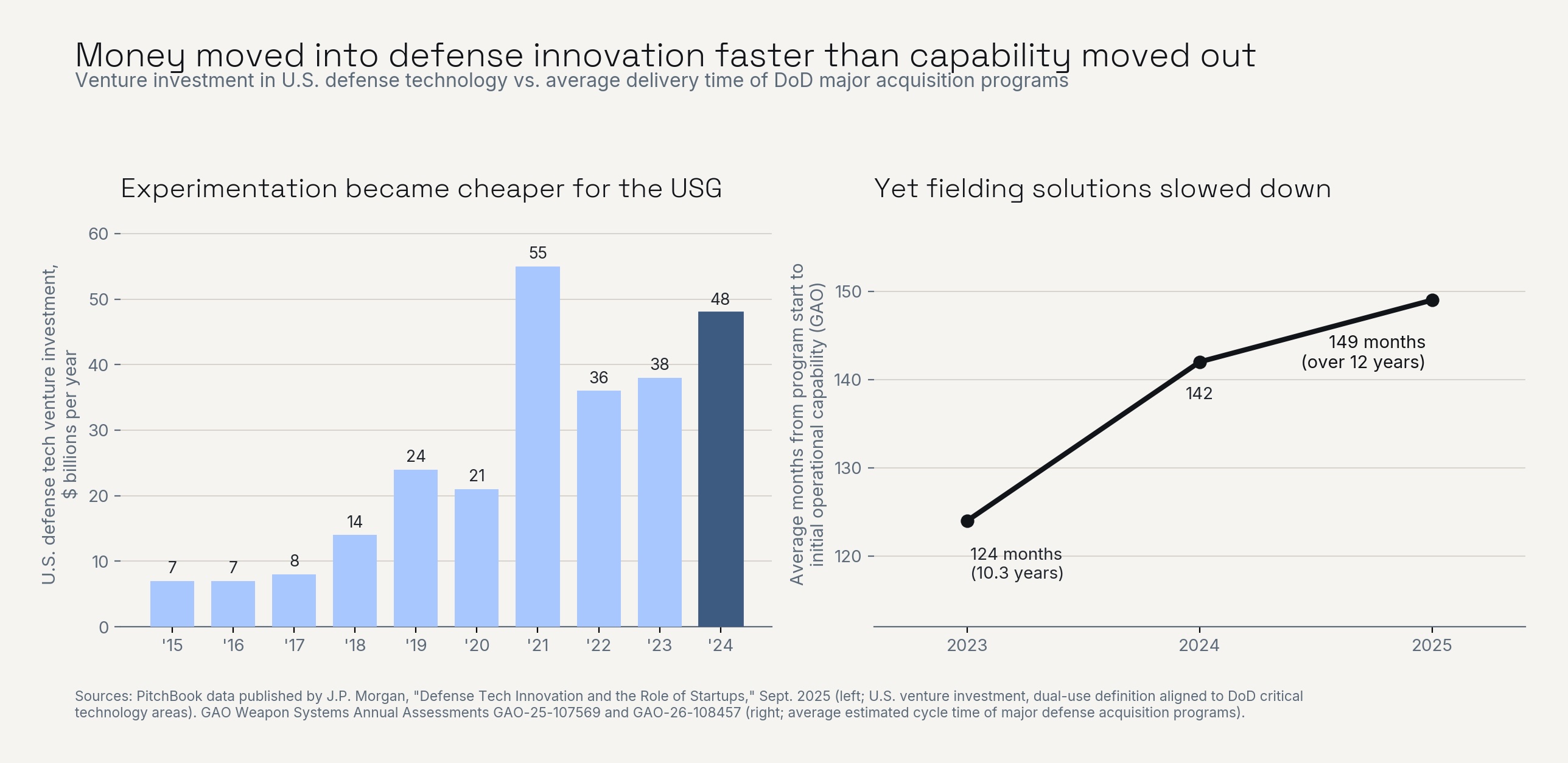
For most of the last few decades, defense acquisition had the opposite cost structure to the one Elman describes. Experimentation was expensive. If a company wanted to test an idea against a military need, that meant months of proposal writing, compliance infrastructure and certifications that most companies don’t have, and then a long wait. Expensive experimentation pushes all the judgment up front, onto paper, before anything gets built; and that's what a requirements process is. Elman describes the old product rituals as things "invented to protect engineering time from bad decisions." The defense versions were invented to protect taxpayer money from bad decisions, which is a righteous goal, but the protection got so thorough that real experimentation nearly stopped.
Fortunately, that cost structure has changed. Commercial technology regularly exceeds the capabilities of legacy defense programs, and new rapid acquisition pathways are launching routinely. We're part of one. With our partners at GovSignals, BMNT operates SOF RACER, which gives companies a fast track to deliver technology directly to special operators from seabed to space, including domains like robotics, drones, logistics, energy, advanced materials, and AI. Membership is free. Companies will respond to solicitations with short solution briefs and the timeline between solicitation and contract award will be measured in weeks.
When experimentation is cheap, the problem is no longer affordability. The problem is experimentation that doesn’t lead anywhere. Elman calls the product version of this “slop.” Defense has had its own version of slop for years, and you’ve seen it if you've spent time in this ecosystem. It’s solutions hunting for problems, demos without customers, and pilots that impress a conference room but not real warfighters. Making experimentation cheap just means that more solutions fall prey to the funding and bureaucratic gap where prototypes fail to transition into permanent, scaled military production contracts.
Nothing posts on SOF RACER until a real customer has a validated problem and validated funding. The government commits first, then industry competes. A founder who spends days on a response is spending those days against demand that exists, from a sponsor who has funding to solve their problem. The companies joining SOF RACER seem to read it the same way we do. One consortium member said: “The traditional distance between a strong technical idea and a fielded capability can be measured in years, not because the engineering is impossible, but because the acquisition process is complex and difficult to navigate. SOF RACER helps create a more accessible route for nontraditional and emerging defense companies to contribute.”
So if you invest in or run a dual-use company, pay attention to SOF RACER. The expected value of time spent responding to a government solicitation has always depended less on the win rate than on a more important question: is the demand real? A serious response to a traditional federal solicitation can take hundreds of hours and thousands of dollars in combined team time, which is particularly frustrating when a lot of that time is spent discovering that the demand was never real.
Today, before a problem reaches SOF RACER members, someone here has asked the old REF questions. Who has this pain? Who above them cares whether it gets solved? Where's the money? These may seem like boring questions, but after a decade of asking them, we're convinced they're the most valuable work we do. No amount of cheap building or automation substitutes for them. We'd rather post fewer problems that are real than a steady stream of maybes, even if the latter look better on a LinkedIn graphic.
Elman closes his article by telling product managers not to let speed replace judgment. It’s fair warning for people building defense acquisition systems, too. The things that deserve more care now are the same things that deserved it at the REF: deciding what problems are worth solving at all, and building the coalition to deliver the solution before the problem changes.
If you build or back dual-use technology, join us. SOF RACER membership is free and takes minutes to start at govsignals-sofracer.fedstart.com.