Agincourt has one year to show what the new command should look like. Here's what it needs to do
On September 30, Secretary Hegseth announced Autonomous Warfare Command, a four-star command charged to “define joint needs” for drones and autonomous systems. To get there, he launched Project Agincourt, a one-year effort to prepare the way for the command. Led by Defense Innovation Unit Director Owen West and Navy SEAL Senior Chief Max Strasiser, Agincourt will prototype what Hegseth called “warfighting acquisition,” putting operators, engineers and companies in fast adaptation cycles. Both are the right moves. Neither yet answers the hardest question: How does a problem seen by a squad on Monday become a fielded option by the end of the month?
The past two years of reform rebuilt the back half of the pipeline. Portfolio Acquisition Executives now own requirements, contracting, test, and sustainment. Money moves faster. But the front end, where problems are detected and defined; and the back end, where we learn whether a fix worked and pass it on, are still left to chance.
Agincourt is the place to fix that. It can build what the force lacks: an arsenal of ready opportunities, and a loop that aims them at problems as they emerge. Two operational concepts already exist to do it. One was written by a combatant command. The other was borrowed from the special operations fight.
The technology to defeat a drone exists. Interceptors work. Electronic warfare works. Directed energy works. The adversary’s advantage is not better gear. It is a faster loop.
In Ukraine, a commercial drone flown on open-source software can change its radio link, its autopilot or its tactics in days. Our answer still moves in months. By the time a validated requirement reaches a program office, the problem it describes is gone. We end up fielding a good answer to last season’s question. The problems that hurt us most are the ones that did not exist last month.
When I ran the Rapid Equipping Force, we fielded hundreds of solutions to soldiers in contact. What we lacked was a way to keep them aimed. We were good at developing and deploying. We had no formal way to detect the next problem early, to measure whether a fix worked, or to share what one brigade learned with every other unit facing the same threat. Most organizations I see today have the same gaps.
U.S. Africa Command has done something most commands have not. It wrote innovation into its operational design. Its draft Joint Concept of Innovation Operations treats innovation as a warfighting function with command and control, doctrine and tasking, not a string of pilots. At its center is the Continuous Innovation Cycle created by innovation strategist Jason KnudsonThe cycle works the way the intelligence cycle does. It runs all the time, on its own rhythm, and feeds every other process. It governs a portfolio of new, pre-program and developmental technologies, and it makes a standing decision on each one: invest, retain, modify or kill. Innovation pipelines, labs and industry feed it. It produces a stocked shelf: an arsenal of opportunities, built before the problem arrives.
AFRICOM’s concept describes that shelf as an armory: a funded technical and programmatic platform that pre-program-of-record capabilities sit on, ready for innovation forces to deploy from. Each new gadget does not need its own wrapper of contracts, sustainment and training. It deploys onto a platform built to support it.
The concept is also clear about who is in charge. Effects in the battlespace belong to operational commanders. Acquisition organizations supply the means, much as a maintenance depot supports aircraft. They do not run the fight.
An arsenal is worthless if no one knows where to point it. That is the job of the Innovation Targeting Cycle, which Steve Blank and I adapted from F3EAD, the Find, Fix, Finish, Exploit, Analyze, Disseminate cycle JSOC used to take apart insurgent networks in Iraq. JSOC did not win by building better weapons. It went from one raid a month to ten raids a night by collapsing the time between intelligence and action.
The Innovation Targeting Cycle applies that logic to warfighter problems. It has six phases:
Each turn of the loop produces the intelligence for the next. A battalion’s loop might run in days and a service’s in months, but they feed each other. The point is not one perfect answer. It is acting on the part of the plan that is good enough, then learning faster than the enemy changes.
The two cycles are not rivals. They are an outer loop and an inner loop, the same way deliberate targeting and time-sensitive targeting worked together in Iraq. JSOC could hit a target the night it was found because years of intelligence work had already built the target folder.
The Continuous Innovation Cycle is the deliberate side. It keeps the arsenal stocked, funded and ready, and it decides what stays on the shelf. The Innovation Targeting Cycle is the time-sensitive side. It finds the new problem, pairs it with the best option already on the shelf, fires, and checks the result. Think of it as weapon-target pairing for innovation.
The handoffs are what make it work. When Assess shows a fix worked across several units, that evidence goes to the Continuous Innovation Cycle as a reason to invest and scale. When it fails, the cycle modifies or kills it. When Detect finds a problem with nothing on the shelf to meet it, that becomes a demand signal to labs and industry. Each loop makes the other smarter.
I learned this at the REF. In 2012, the Combined Joint Special Operations Task Force commander in Afghanistan asked us for a way to clear a three-foot-wide path of IEDs so his operators could reach a target without being blown up. It also had to fit inside a Chinook. We did not start a new development program. We found a robotics package on a tracked Bobcat that had been used to place sensors at the Fukushima nuclear plant after its meltdown. We married it to part of a mine plow built for the M1 tank, and the Navy did rapid software work to make the pieces talk. The first systems, called Minotaur, reached Afghanistan within eleven months.
None of those parts were new. What was new was pairing them with a precisely defined problem, fast. At the REF, that took a few people who knew where to look. An arsenal makes it the system’s job.
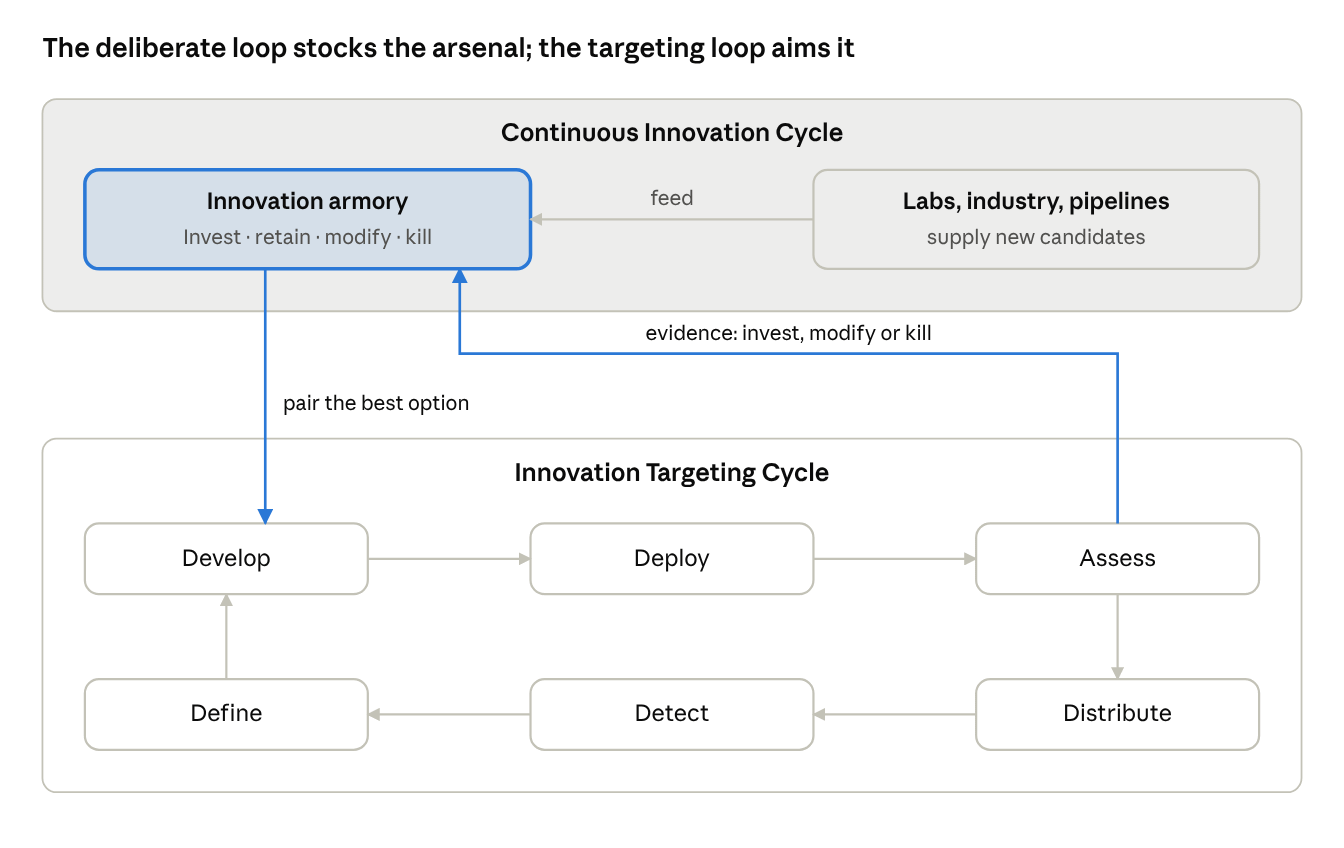
The arsenal hands the targeting loop its options; the targeting loop hands the arsenal its evidence.
The result is a commander who meets a new threat with opportunities already in hand, not a requirements document and a long wait.
Agincourt has one year to show what the new command should look like. That makes it the natural proving ground for a new front end. Five steps would get it there.
Autonomous Warfare Command will “define joint needs.” Agincourt is where it can learn how. If the command’s needs come from this loop, they will be grounded in what operators see. If they come from headquarters staff, we will buy the wrong drones faster.
The side that wins the drone fight will not be the side with the best drone. It will be the side whose loop turns fastest. Build the arsenal, and the loop that aims it.
The Department of War has spent two years making it faster to buy things. Now it needs to get faster at knowing what to buy, whether it worked, and who else needs it.
The pieces already exist. AFRICOM wrote the outer loop into doctrine. The targeting cycle that took apart insurgent networks gives us the inner one. Agincourt gives us a place to run both, with operators in the room and a new four-star command waiting for the answer.