New consortium is free for members, which changes everything about how defense ecosystems get built. It's about time.
For two decades, the price of entry to most defense consortia has been paid by exactly the wrong people.
If you’re a commercial company that wants to solve problems for the Department of War, the standard deal looks like this: pay annual dues for the privilege of seeing opportunities. Then, if you’re good enough to win work, hand over a percentage of your award. The organizations running these vehicles collect twice — once at the door, once from every win — from the very companies the Department keeps saying it desperately needs.
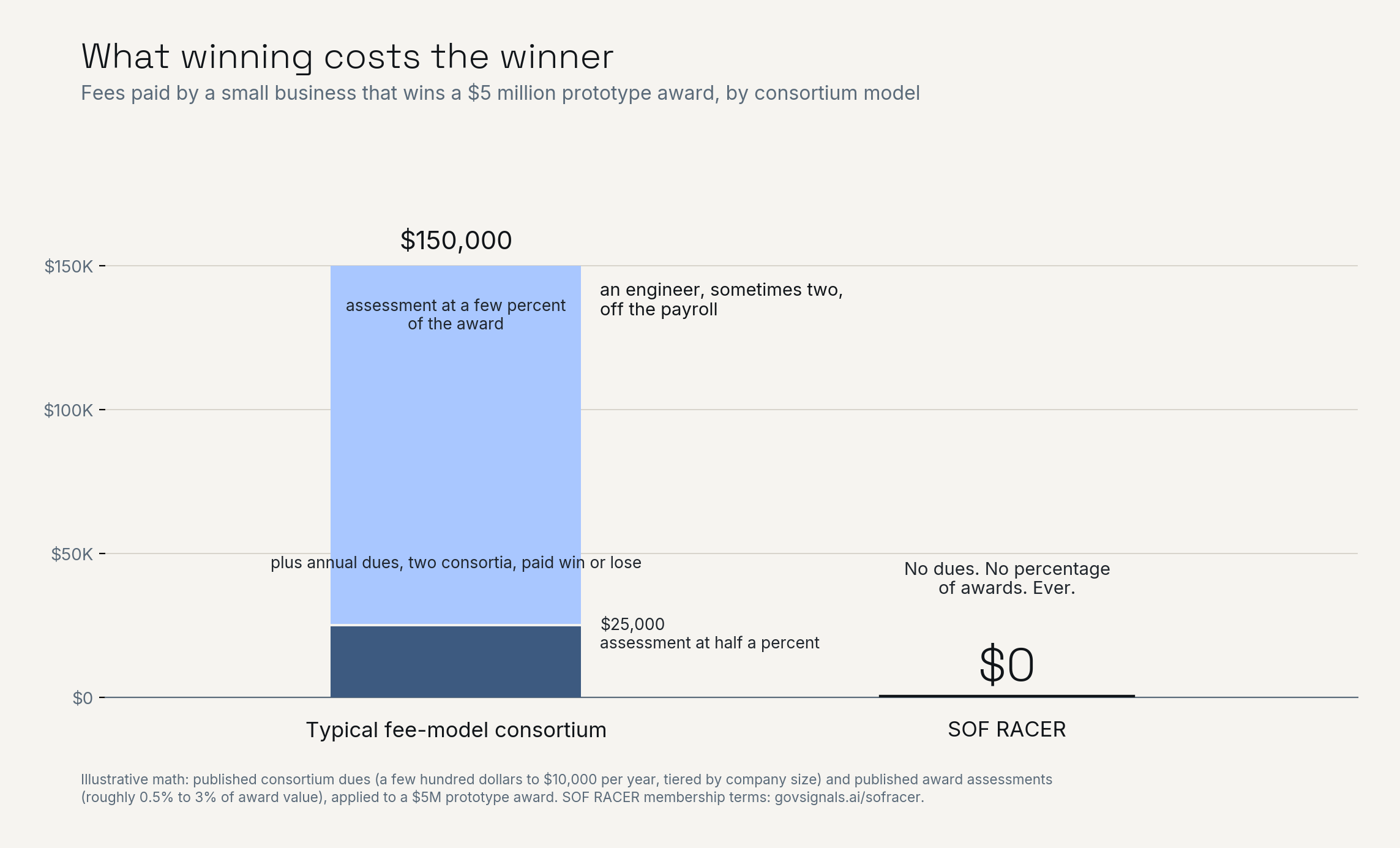
The numbers are public, if rarely totaled. Annual dues across the major consortia run from a few hundred dollars to $10,000 a year, tiered by company size. Assessments on awards — published rates typically between half a percent and a few percent of award value — come off the top of every win. Now do the math for a small business that joins two consortia to cover its market, waits 18 months for the right solicitation, then wins a $5 million prototype: several thousand dollars in dues just to stay in the room, then somewhere between $25,000 and $150,000 surrendered from the award itself. That is an engineer — sometimes two — taken off the payroll of exactly the company the Department is trying to grow.
And the companies that competed and lost? They paid the dues anyway.
Call it what it is: a tax on the defense industrial base, levied hardest on the newcomers.
The fee model doesn’t just cost companies money. It quietly bends the entire institution around the wrong goal. When a consortium’s revenue is a cut of member awards, members become the revenue line. The rational strategy is volume: recruit everyone, keep everyone, let the roster swell into the thousands, and call the roster an ecosystem.
But a roster is not an ecosystem. A mailing list of dues-payers is not a community of solvers. Companies figured this out a long time ago — ask any founder who paid dues for two years, watched opportunity emails pile up unread, and quietly stopped renewing. In our years running innovation pipelines across the Department, we’ve seen what actually pulls the best nontraditional companies into national security work, and it has never once been a fee structure. It’s the pull of hard, mission-relevant problems, well framed, with a real path to a real customer. Companies join for relevance and engagement. Everything else is friction.
And to be clear: this is the Department of War’s problem, not a vendor-welfare complaint. A toll at the door runs a quiet adverse selection against the mission — the companies most willing to pay it are the ones with the fewest alternatives, while the companies the Department wants most, the ones with thriving commercial businesses and zero patience for friction, never show up at all. The fees that do get paid don’t vanish, either; they get priced into proposals or carved out of prototype scope, so the government ends up paying the toll itself and receiving less technology per dollar. A consortium optimized for enrollment hands its sponsor thinner fields, weaker competition, and slower fielding — and the warfighter pays the residual.
This month, USSOCOM’s SOF Acquisition, Technology and Logistics directorate launched SOF RACER — the Special Operations Forces Rapid Acquisition Consortium for Emerging Requirements — with GovSignals as its partner and BMNT running the human engine. And SOCOM made the design choice we think every consortium sponsor will eventually copy:
It is free for vendors. No dues. No percentage of awards. Ever.
How? SOCOM pays the operators a firm, fixed price to run the consortium well — the model the federal government’s own April 2026 Executive Order now makes its preferred approach to contracting. Our incentive is throughput and speed, not fees — and that isn’t a slogan, it’s the scoreboard. The commitments we’re graded on look like this: a new company onboarded and bid-eligible within ten business days of first contact. Three to five credible competitors on every solicitation, not 300 long shots or one incumbent. Award executed inside 90 days of a solicitation posting, driving toward 70. If the consortium doesn’t perform against numbers like these, we don’t deserve the next option year.
Let that inversion sink in for a second. In the old model, the manager wins when the roster grows. In this model, the operators win only when the mission does — when qualified companies compete, when awards move fast, and when technology actually reaches the force. The paying customer is the command, the metric is delivery, and the members are what they should have been all along: the talent, not the product.
We’ve watched what that difference means for a real company. An ocean-data startup we worked with had built its business selling wave and weather intelligence to shipping and surf forecasting; its buoys ended up supporting naval special warfare missions. A silicon-photonics company making chip-scale navigation for the autonomous-vehicle world saw its inertial unit go to an operational task force. Neither paid dues to anyone. Neither surrendered a percentage of anything. They were found because their technology fit a well-framed problem, prepared to compete by people whose job was preparing them, and fielded. That is what “talent, not product” looks like in practice — and SOF RACER industrializes it.
Free membership isn’t generosity. It’s what unlocks the operating model we’ve always wanted to run at this scale.
Problems arrive in plain English. Before anything posts, our team interviews the people who own the problem and writes it the way an engineer can act on it — what SOCOM is trying to do, under what constraints, and what success looks like. Companies respond with short solutions briefs, not hundred-page proposals. Awards are built to move in weeks. And a successful prototype has a lawful, established path to a production contract without another competition — the bridge across the valley of death, written into federal law, that most companies never learn exists.
None of this is theory for us. The process underneath SOF RACER — interview the people who own the problem, frame it in plain language, curate a small field of right-fit companies, move fast to award, and support the technology through transition — is the same method BMNT has run across the Department for years. It produced 25-plus competitive awards at a 70-day average for the Defense Logistics Agency. It turned $21 million in seed awards into more than $407 million of follow-on private capital for an OSD program. And it traces straight back to the Army’s Rapid Equipping Force, which our founder led. SOF RACER points that method at SOCOM’s 12 areas of interest — C4ISR to robotics to energy to data/AI, from seabed to space.
Here is our definition, and the standard we intend to be graded on: an ecosystem is measured by engagement, not enrollment. Qualified companies per area of interest. Competition rates per solicitation. Time from problem to award. First-time defense vendors who come back for a second competition. Those numbers — not roster size — will tell whether SOF RACER is working, and we intend to publish our speed against them. We think this model will spread beyond SOCOM, because the logic isn’t SOCOM-specific: every command, agency, and program office buying innovation through a fee-taxed vehicle is paying an invisible toll on the exact companies it wants most. The commands watching this launch should ask their consortium managers one simple question: who pays you, and for what?
The door costs nothing to walk through. Join the waitlist at govsignals.ai/sofracer — it takes two minutes. Come to the virtual industry day on August 20, 9:00–10:00 AM ET, where we’ll walk through exactly how to engage and answer questions live. And if you’re not sure where your technology fits among the 12 areas, tell us — matching companies to problems is literally our job. The consortium tax is over. What replaces it is a race — and it started this week.
Brian Miller is the President of BMNT