Section 873 can accelerate defense investment—if combatant commands can turn operational needs into compelling evidence
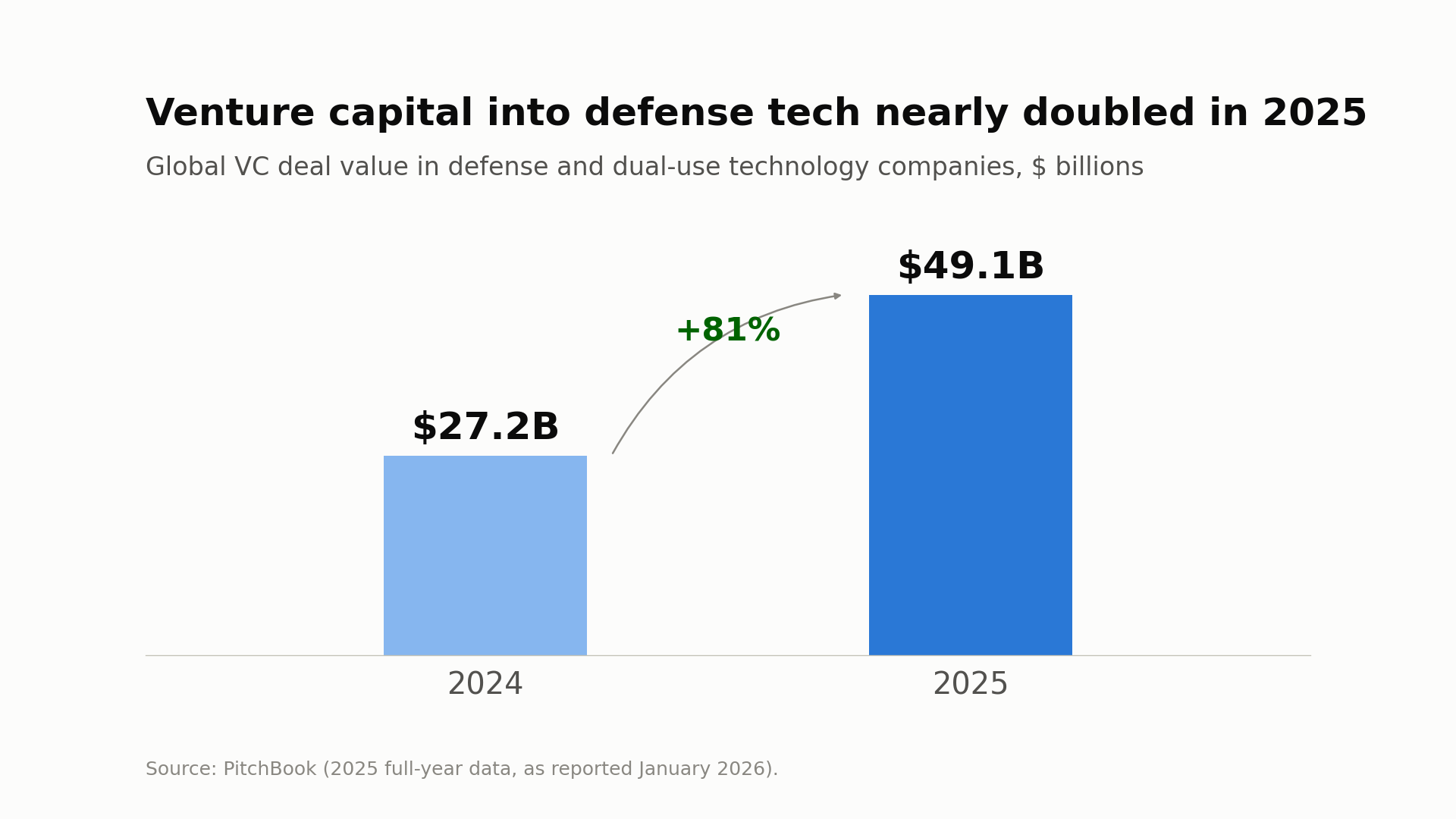
Private capital is pouring into defense technology. Investors put $49B into defense tech companies in 2025, according to PitchBook, nearly double the year before. However, most of it isn’t going where it could do the most good because investors rarely see an actual demand signal.
The U.S. combatant commands know what is breaking in their geographic or functional areas, and which capability gaps keep planners up at night. They handle all military operations in a specific part of the world like Indo-Pacific Command or Central Command or for a special global task like Transportation Command. Their knowledge is valuable input for any defense investor, but it typically stays inside a headquarters or gets communicated so generally that no one can act on it.
For decades, this was nobody’s fault. Special Operations Command has had its own buying authority for decades, but combatant command could only educate the market by hosting an industry day, sharing operational context, and describing its priorities. All three were useful, but because the command couldn’t buy anything, companies and investors treated its signals merely as interesting background. Meanwhile, the command lived with the consequences. The military service departments, which train, equip, and manage the soldiers, sailors, airmen, marines, and guardians, bought on their own timelines and against their own priorities. When a needed capability stalled in the so-called “Valley of Death,” the command dealt with the gap because it's accountable for all outcomes in its area of operations even though it had almost no control over the supply side.
Congress changed that with Section 873 of the FY26 National Defense Authorization Act (NDAA), which gives combatant commands the authority to sponsor experimentation, prototyping, and technology demonstrations against their own operational needs. More importantly, a completed demonstration can support acquisition decisions. In plain terms, a command can now test a promising commercial solution against its own problems, in its own theater, and the result carries real weight inside the acquisition system. The services still control most of the funding, and no demonstration obligates the government to buy, of course. But a command can now do more than describe its problems; it can put proof behind them.
Combatant commands are now capable of driving markets. When they publish a specific, validated problem and offer a credible path to demonstrate against it, three things happen: Capital concentrates on real gaps instead of fashionable ones; companies build toward user-driven requirements instead of guesses; and when a demonstration succeeds, there’s an artifact the acquisition system can act on.
The catch is that Section 873 authority arrived with no money or staff attached. A command that wants to use the new authority well has to run four functions as a standing process, and each one is harder than it looks.
Problem Curation comes first. Broad needs like "counter small drones at scale" have to become specific, testable problems, validated with the operators who experience them. That takes structured discovery. Sourcing solutions comes next. Someone has to find and vet the emerging companies with the right capability, and the right answer is rarely the familiar names that already show up at industry days. Then the experiment itself has to be designed. It takes real work to incorporate a demonstration into a live exercise, with measures rigorous enough that the resulting data means something to an acquisition official. This means it cannot be improvised in the weeks before the event. Finally, the results have to become documentation that a service, an agency, or an ally can actually buy against, with a named owner tracking each one.
The pipeline numbers from one organization show what this takes. Standing up a technology accelerator at a combat support agency meant roughly 600 discovery interviews to surface about 200 problems worth solving in the first year. Scanning 500 companies produced a few dozen worth moving into prototyping. That’s three interviews for every real problem and 14 companies for every one worth funding. Skipping this work leads to demos that don’t prove much and data that no one will use in a program review.
The temptation over the next year will be to celebrate the new authority with events like investor forums, innovation showcases, panels on bridging capital and capability. Convening is fine, and getting the right people in the room is harder than it sounds. But capital commits where there is signal, and the commands that treat Section 873 as an operating system rather than an announcement will find that the market comes to them, because they will be offering something investors cannot get anywhere else: demand they can believe. Success here is measured in the number of experiments, demonstrations that produce documentation that acquisition professionals can act on, funding moved onto contract, and private capital leverage.
If you’re a senior leader in a combatant command, you do not need an event to start. Ask your team three questions: Do we have a list of problems specific enough that a company could build against them? If a demonstration succeeded at our next exercise, what document would it produce, and who could buy from it? Who owns the answer 90 days later? If the answers aren’t sufficient, the gap is capacity and that is where the work starts. It’s better to find out now before a lot of time and effort is spent on the wrong activities.
Brian Miller is the President of BMNT, a government innovation company building both halves of federal innovation that don’t get built on their own.