War is not a math problem. Let's stop treating it that way.
Editor’s note: A version of this article first ran in The National Interest.
Twenty years ago, the DoW invented the Warfighter Acquisition System. It was called the Rapid Equipping Force. But after its success in Iraq and Afghanistan, the Army’s senior leadership abandoned it for the status quo.
We deluded ourselves that if we spent enough time analyzing a gap, writing a capabilities document, and staffing it through the Pentagon bureaucracy, we could predict the future of warfare with engineering precision. We treated war like a math problem that can be solved in a cubicle in Arlington, VA.
Here’s hoping we don’t abandon it again.
War is not a math problem. It is a chaotic, human endeavor that evolves faster than any committee can adjudicate. I learned this the hard way.
In 2010, following a tour as an infantry brigade commander in Iraq, I took command of the Army’s Rapid Equipping Force (REF). We were in the thick of the fight in Afghanistan and Iraq. Soldiers were dying from threats that didn’t exist when their equipment was designed 10 years prior. I watched units struggle with gear that was “fully compliant” with DoD regulations but utterly useless against the enemy they faced that morning. And I listened to commanders struggle to articulate what I could do to solve their problems.
The acquisition system—the machine built to equip our forces—was killing us. It was obsessed with “Big A” Acquisition: the multi-billion-dollar programs of record that took decades to field. It was risk-averse, process-heavy, and blind to the urgency of the now.
We didn’t have time for the Joint Capabilities Integration and Development System (JCIDS). We didn’t have time for a three-year Analysis of Alternatives. We had days, maybe weeks, to save lives.
So, we broke the rules. Or rather, we took advantage of the exceptions we were granted and rewrote the rules for the reality of the battlefield. We stopped asking soldiers for “requirements.” A soldier under fire doesn’t have a requirement for a specific spectral sensor with a specific mean-time-between-failure. They have a problem: “I can’t see who is planting IEDs in the culvert down the road at night.”
REF introduced the “10-liner.” It was exactly what it sounds like—a 10-line form that stripped away the bureaucratic fluff. Problem. Justification. Concept of Operation. That was it. If a soldier could articulate the problem, we accepted the risk. We sourced the problem, curated it to ensure we weren’t just putting a band-aid on a symptom, and went to the commercial world with a checkbook and a challenge.
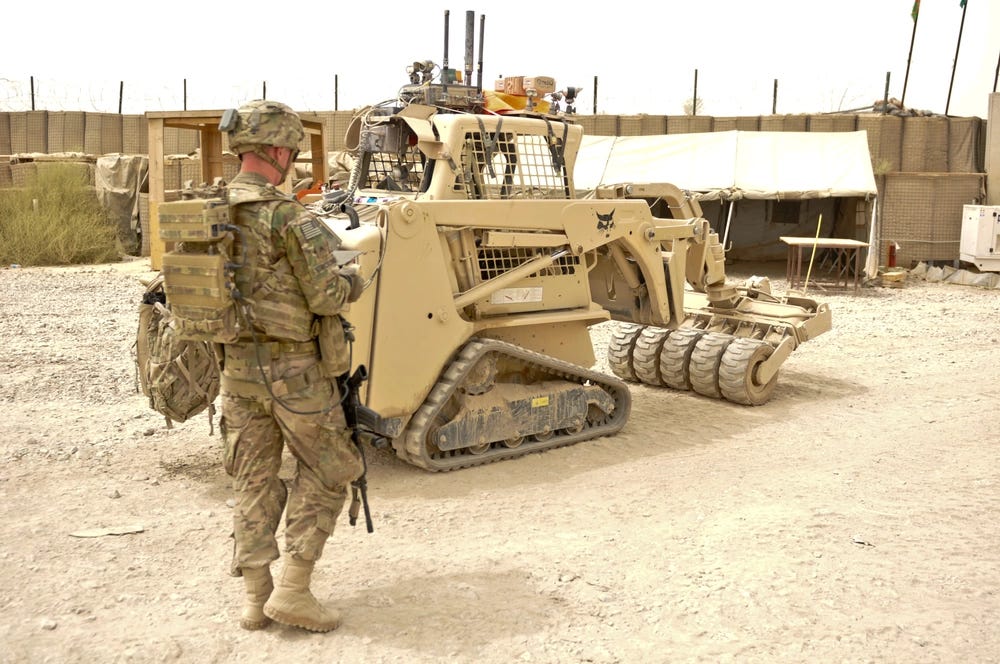
We found that when you lead with the problem, American ingenuity responds. We didn’t hand industry a 500-page spec sheet; we handed them a problem set. And they delivered—robots, sensors, power systems—in an average of 140 days. We weren’t looking for the “perfect” solution that would last 30 years. We were looking for the “80% solution” that would work now.
For years, I have argued that we need to scale this mentality. The REF shouldn’t have been an anomaly; it should be the model. And finally, it seems Congress agrees.
The Conference Report for the Fiscal Year 2026 National Defense Authorization Act (NDAA) contains the most significant acquisition reforms since Goldwater-Nichols. It is a direct assault on the “requirements-first” culture that has paralyzed our modernization.
Specifically, the establishment of Portfolio Acquisition Executives (PAEs) changes the game. By creating leaders responsible for a “portfolio of capabilities” rather than isolated programs, we are finally creating an architecture that can support a “portfolio of problems.”
Here is why this matters: In the old system, if you were the Program Manager for a tank, your job was to build the best tank possible, even if the enemy stopped using tanks. You had no authority to pivot. In the new PAE system, a leader managing a “Maneuver Portfolio” has the authority to look at the battlefield, see a new drone threat, and reallocate resources from heavy armor to kinetic countermeasures in real-time. They are managed by outcomes, not by adherence to a stale requirements document.
But statutory authority is just paper if we don’t change the culture. We need to adopt a Problem-First Doctrine.
To make the 2026 NDAA reforms work, the Services must fundamentally alter how they interact with industry and their own forces. I recommend the following immediate actions:
1. Institutionalize Problem Curation.
Every PAE must have a dedicated “Problem Curation” cell. Just as we have “requirements officers,” we need trained curators whose sole job is to work with warfighters to validate the context of a problem. They must answer the hard questions: Is this a tech problem or a training problem? Who else has this problem? Who actually cares about this? What does “good” look like? Without curation, the new PAEs will just become faster engines for buying the wrong things.
Likewise, warfighting elements should be required to stand up problem-sourcing and curation elements in their own ranks to add volume to the pipeline of problems fielded by the PAEs.
2. Kill the “Requirement” as the Entry Ticket.
Stop demanding that startups and commercial companies map their technology to a rigid DoD requirement. Instead, PAEs should publish “Portfolios of Problems.” Tell industry what is keeping commanders up at night, not how to build the sleeping pill. This opens the door to non-traditional vendors who have cutting-edge tech but no patience for the FAR. In fact, DoW leaders and Congress should require PAEs to brief their problem portfolios before discussing budgets for solutions.
3. Embrace the “10-Liner” Standard.
The new “Requirements, Acquisition, and Programming Integration Directorate” (RAPID) mandated by the NDAA should adopt a standard similar to the REF 10-liner for all urgent and emerging needs. If a “requirement” cannot be articulated in two pages, it is not a requirement; it is a wish list. Complexity is the enemy of speed.
4. Train for Curiosity, Not Compliance.
We need to retrain our acquisition workforce. We have raised a generation of program managers who are experts in compliance but novices in curiosity. They know how to audit a contract, but don’t know how to interview a user to discover the root cause of a failure. We must invest in “Mission Engineering,” “Lean,” and human-centered design training for everyone involved in the process, from the front lines to the acquisition corps.
5. Kill the slow movers.
PAEs need to kill solutions whose problems have changed to the extent that they are no longer valid. To retain the velocity of delivery, PAEs need to be solution agnostic while laser-focused on solving the problems in their portfolios - meaning they kill anything in their portfolio that is consuming resources yet not solving a problem at the speed of relevance.
The 2026 NDAA has given us the cover fire we needed. The law now says we must prioritize speed. We must define operational problems. We must empower portfolio managers to take risks.
The accountants have been overruled. The bureaucrats have been given new orders. The Department of War is finally pivoting to face the reality of the 21st century. But laws don’t win wars; people do. It is up to us to seize this opportunity, kill the requirement, and unleash the problem-solvers. The warfighter is waiting.