DoW has reformed how it acquires. It has not reformed what it acquires, whether it worked, or who else needs to know
When Steve Blank and I sat down over coffee a decade ago and realized that the customer discovery process in Lean was identical to what I’d been doing with the Rapid Equipping Force in Afghanistan, neither of us imagined we’d still be making the same argument in 2026. But here we are.
The Department of War has just executed the most ambitious acquisition reform in 60 years. Portfolio Acquisition Executives have replaced PEOs. JCIDS is dead. The Warfighting Acquisition System rewards speed to delivery. These are real reforms, and they implement nearly every recommendation the defense innovation community has made for the last decade.
And they are about to repeat the most expensive mistake of the post-9/11 wars.
Here’s why.
Everyone in Washington is talking about the counter-UAS challenge as though it’s an engineering puzzle. Build a better jammer. Field a cheaper interceptor. Develop AI-enabled target recognition. The technology shelf is full: directed-energy weapons at $12 per shot, drone-on-drone interceptors with over 1,000 kills in Ukraine at $14,500 each, electronic warfare systems that can defeat commercial flight controllers.
The technology works. The process for getting it to the warfighter does not.
A new drone variant appears on the battlefield every week --- built from commercial parts, open-source flight software, and components available on Amazon and Alibaba. A firmware update that defeats your jammer costs nothing and takes hours. Your counter to that update, through even the reformed acquisition system, takes months.
This is not a technology gap. This is a cycle-time gap.
And I’ve seen this exact gap before.
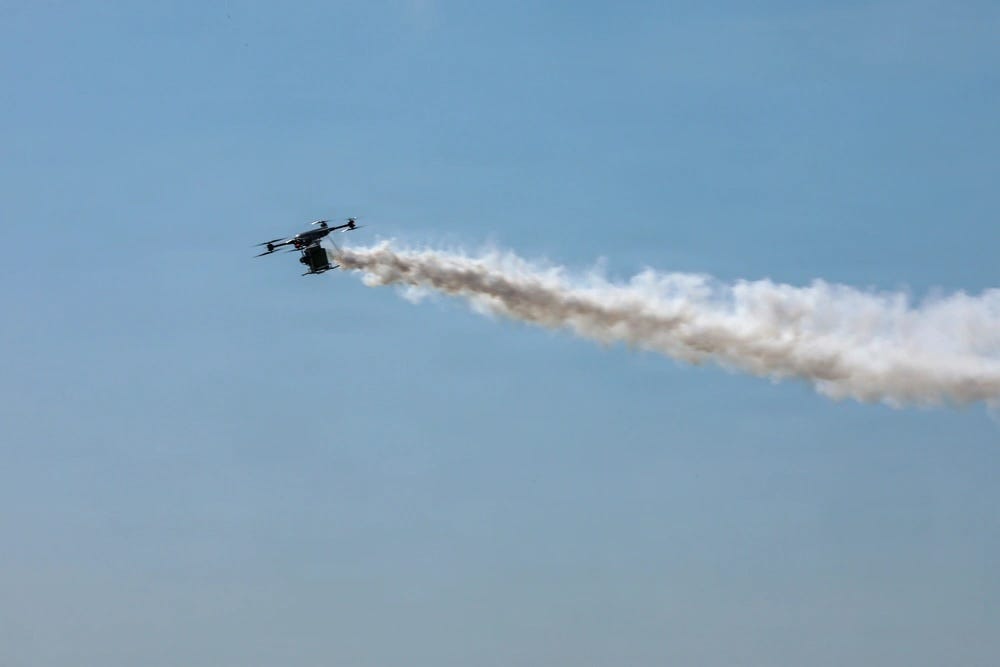
From 2010 to 2013, I led the Army’s Rapid Equipping Force during the height of the counter-IED campaign in Afghanistan. The structural parallels between that fight and the current counter-drone fight are not approximate. They are exact.
Both threats share five characteristics that make them resistant to conventional acquisition:
Steve and I have spent the last decade teaching the same lesson: the quality of your solution is determined by the quality of the problem you choose to solve. Or as Einstein reportedly said, if given one hour to save the world, spend fifty-five minutes understanding the problem and five minutes on the solution.
The Pentagon’s C-UAS response addresses the last 5 minutes of the equation, not the first 55.
The Department has invested heavily in the develop and deploy phases. JIATF-401 was stood up last August to proliferate counter-drone capabilities. The Army runs biennial industry competitions. DIU scouts commercial technology. The PAE reform consolidates requirements, contracting, testing, and sustainment under a single portfolio leader. These are the middle phases of the innovation cycle, and they are getting real investment and real attention.
But nobody is doing the other four things:
Detect --- Nobody is persistently monitoring how the drone threat evolves at the tactical edge. There are no forward-deployed problem discovery teams embedded with operational units, scanning for how the adversary adapted since last week. The REF & AWG had these teams. They no longer exist.
Define --- Nobody is scoping the specific problem each unit faces with enough precision to drive useful solutions. A PAE leader at headquarters, no matter how empowered by the new reforms, cannot see the distinctions that matter without ground truth from the fight. Requirements still originate from within the institutional system --- headquarters staffs, Service-level assessments --- not from soldiers and Marines observing the problem in context.
Missing also is a Fusion Cell that collects the inputs from the operational force, industry and the labs and executes the discovery required to confirm we are working on actual problems (not symptoms) and the required speed to solve them.
Assess --- Nobody is systematically measuring whether fielded C-UAS systems actually work against an adversary who adapts after every engagement. We field systems and declare victory. Without assessment, there is no feedback loop. Without a feedback loop that anticipates adaptation, you cannot out-cycle the adversary.
Distribute --- Nobody is ensuring that what one unit learns reaches every other unit facing the same threat at operational speed much less delivers that same assessment to industry. The Asymmetric Warfare Group used to do this with forward deployed embeds, rolling assessments back into TRADOC schoolhouses. That function was absorbed by the Center for Army Lessons Learned, which operates at institutional tempo --- months --- not operational tempo.
Three of six phases of the innovation targeting cycle have no organizational owner. The reforms built a faster engine. Nobody built the steering.
Let me be clear: the PAE restructuring is genuine progress. Consolidating authority under a single portfolio leader eliminates the handoff delays between requirements writers, program managers, and testers that killed tempo under the old PEO structure. The new Capability Trade Councils can make real-time tradeoffs. Killing JCIDS removes the most ossified layer. These are serious reforms.
But they widen the scope of who writes requirements without changing where the inputs come from.
At the REF, we didn’t just have streamlined requirements authority --- though we had that. I could validate a requirement and commit funds on the spot. The REF’s real advantage was something else entirely: forward-deployed teams generating requirements from direct observation of the fight. Any soldier, from private to four-star, could submit a problem via a one-page 10-Liner. We aimed for 90-day solutions and sometimes delivered in 72 hours. We transitioned 170 programs into production and leveraged $150 million into ten times that through partnerships. Our Expeditionary Lab at Bagram fabricated prototypes in days.
That wasn’t just fast acquisition. That was problem curation at operational speed --- sourcing problems from the field, validating them through direct observation, and converting them into actionable problem statements before committing resources to solutions.
The Army disbanded the REF and the Asymmetric Warfare Group in 2021. It has not replaced either. We eliminated our most effective problem-detection and solution-distribution capabilities just as the drone threat was accelerating.
The solution is not recreating the REF or AWG. It is ensuring that all six phases of the innovation cycle have organizational owners, dedicated resources, and a shared operational tempo.
I call this the Innovation Targeting Cycle, modeled on the F3EAD process --- Find, Fix, Finish, Exploit, Analyze, Disseminate --- that JSOC used to dismantle terrorist networks in Iraq. Gen. Stanley McChrystal’s Joint Special Operations task force went from one raid a month to ten raids a night not because it got better technology, but because it collapsed the cycle time between intelligence and action. Every raid generated the intelligence for the next one. Every completed cycle made the next cycle faster.
The same logic applies to innovation. Six phases --- Detect, Define, Develop, Deploy, Assess, Distribute --- run continuously by a fusion cell, each rotation generating the input for the next. A 70% solution fielded in weeks, assessed against operational reality, with findings distributed across the force and fed back into detection of the next problem.
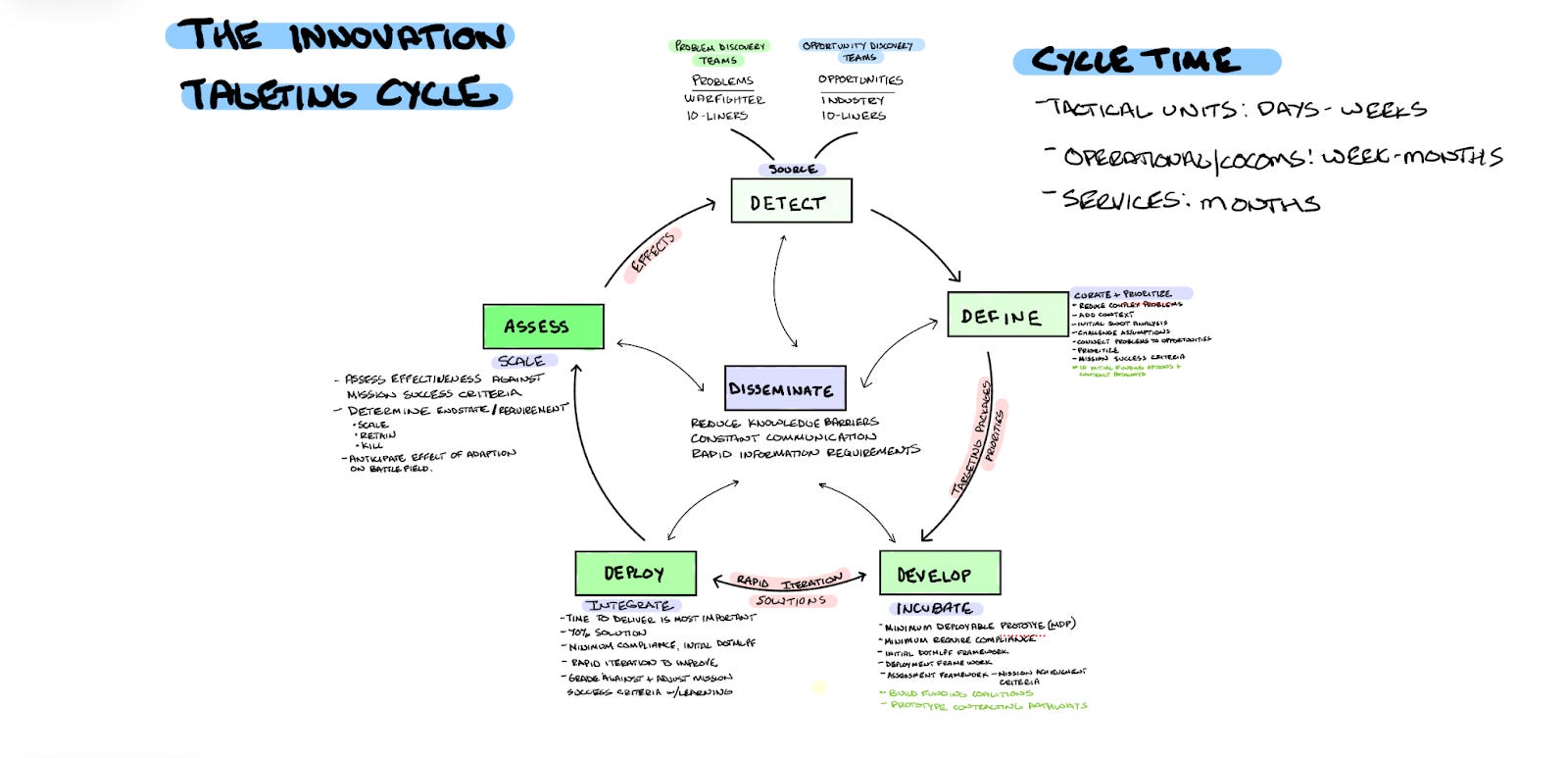
The PAE reforms provide the authorities and organizational structures for Develop and Deploy. The Innovation Targeting Cycle provides the front end and back end that connect the warfighter’s reality to those authorities.
Each PAE needs four things the current reforms don’t provide:
The Department has reformed how it acquires. It has not reformed what it acquires, whether it worked, or who else needs to know.
In the counter-drone fight, that gap is not academic. The adversary doesn’t need to out-technology us. He only needs to out-cycle us.
We proved with IEDs where that leads. $75 billion. Two decades. We lost.
The same fight is here again. The technology is better this time. The process failure is identical. You don’t beat an adaptive threat by building a better mousetrap. You beat it by running a faster, smarter cycle --- one that starts with understanding the problem, not building the solution.
That’s the lesson of Lean. That’s the lesson of the REF. And if the Pentagon doesn’t learn it this time, the drones will teach it the hard way.
Pete Newell is the former director of the U.S. Army’s Rapid Equipping Force and CEO of BMNT. He co-created Hacking for Defense with Steve Blank and is the author of “The Innovation Targeting Cycle: Time-Sensitive Innovation Fires Inside the Continuous Innovation Cycle.”