Time-sensitive innovation fires inside a continuous innovation cycle
The Department of War’s 2025 acquisition reforms — the Warfighting Acquisition System, Portfolio Acquisition Executives, the Army’s PIT, the Navy’s NRCO, AFWERX, SOCOM’s Sonic Spear — represent the most significant structural changes to defense acquisition in decades. They are designed to accelerate the delivery of capability to the warfighter, and they address a real and urgent problem.
But speed of delivery, by itself, is incomplete.
The current reforms are heavily weighted toward the develop and deploy phases of innovation. They assume the right problems are already known, that requirements will continue to flow from traditional channels, and that the primary bottleneck is in development and delivery. They do not systematically address the equally critical functions of detecting problems from the operational edge, defining them with precision, assessing whether solutions actually worked, and distributing findings across the force and industry.
Without those phases, even the fastest acquisition system risks making the wrong things go faster.
The Innovation Targeting Cycle (ITC) borrows its logic from the F3EAD intelligence targeting cycle — Find, Fix, Finish, Exploit, Analyze, Disseminate — that Joint Special Operations Command used to dismantle terrorist networks in Iraq. When General Stanley McChrystal took command of JSOC in late 2003, the task force was built to execute one or two high-fidelity raids a month. By collapsing the space between intelligence and operations, fusing analysts and operators into a single battle rhythm, and building an industrial process for post-raid exploitation, McChrystal’s JSOC compressed cycle time from weeks to hours — going from roughly one raid per month to ten or more in a single night, with each raid generating the intelligence for the next.
The same transformation is needed in defense innovation. The ITC adapts F3EAD into six phases — Detect, Define, Develop, Deploy, Assess, Distribute — that compress the time between discovering a warfighter problem and fielding a deployable solution, while constantly feeding operational results back into the cycle to generate new targets. Where F3EAD targets adversaries, the ITC targets warfighter problems. Where F3EAD generates kinetic effects, the ITC generates innovation fires — the deliberate employment of innovation capability to create operational effects.
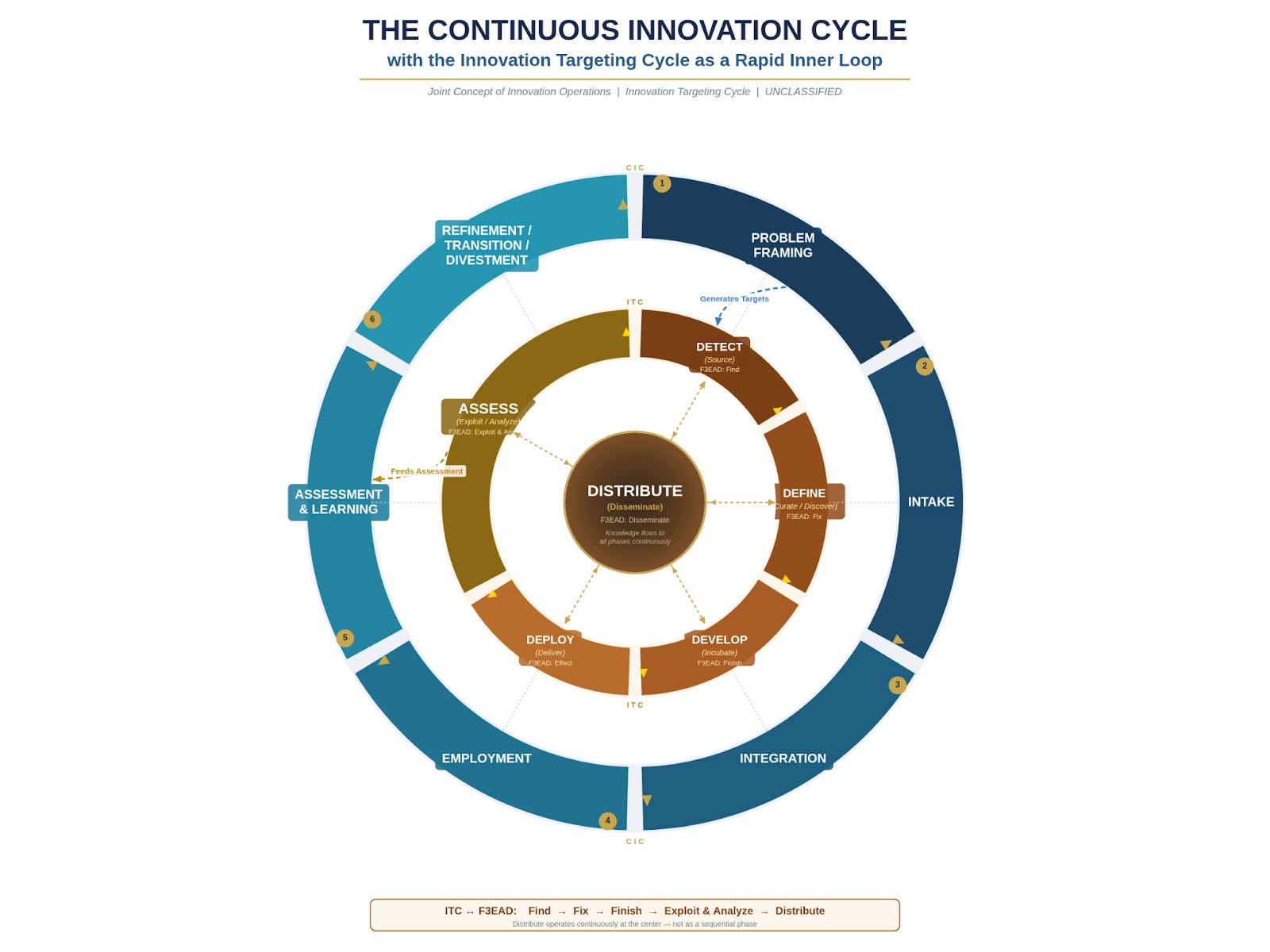
The ITC is not a replacement for the Innovation Pipeline, the Warfighting Acquisition System, or the broader Innovation Operations construct described in the Joint Concept of Innovation Operations (JCIO). It is a rapid, operational-tempo targeting process that runs inside those larger constructs, providing the speed and feedback that turns institutional processes into something that outpaces the problems they are trying to solve. The relationship is analogous to how F3EAD relates to the broader intelligence and fires enterprise: F3EAD does not replace JIPOE, the Joint Targeting Cycle, or deliberate targeting. It operates within and alongside them, providing rapid, iterative tempo for time-sensitive targets.
Version 2.0 of this document integrates the execution framework required to move the ITC from a conceptual model to a repeatable operational capability. This includes the Innovation Targeting Fusion Cell — a J3-led, cross-functional node that collapses cycle time by co-locating operators, intelligence, engineers, assessment, and acquisition enablement into a persistent operational team. It includes the Forward-Deployed Maintenance and Development Facility (FDMDF) — the forward physical node of the Innovation Operations Platform that executes integration, testing, release packaging, and fielding-kit production at speed. And it includes Innovation Operations Support (IOSpt) — the acquisition and institutional enablement construct that mans, trains, equips, and scales the system.
The ITC executes across three echelons: tactical units in contact generating evidence on a cycle of days to weeks; the operational Fusion Cell running the engine on a cycle of weeks to months; and the strategic echelon providing governance, disposition, and scaling on a cycle of months.
Historical precedents validate the ITC’s logic. The Rapid Equipping Force excelled at Develop-Deploy but lacked formal Assess and Distribute phases. The Asymmetric Warfare Group was strong at Detect-Define-Distribute but had no authority over material development. DIU contributed powerfully to Develop-Deploy but a 2025 GAO assessment found it still lacks performance metrics — a direct reflection of the missing Assess phase. No organization has ever run the full cycle. The Department disbanded both the REF and AWG in 2021 without replacing their forward-deployed problem detection and solution dissemination capabilities. The ITC is the framework for reconstituting them — not as niche organizations on the margins of acquisition, but as the operational targeting process at the center of it.
The Department is reforming how it acquires. The Innovation Targeting Cycle provides the discipline for what it acquires, whether it worked, and who else needs to know. That is the difference between going fast and going fast in the right direction.
Download the full document: The Innovation Targeting Cycle v2.0 (PDF)